Communications Biology | Neural mechanisms of feature binding in working memory (online)
When we briefly remember a scene (e.g., “a cup of coffee on the table”), the brain must not only store what and where, but also keep their correct pairing—a process known as feature binding in working memory. In our newly published online study, we combined fMRI with graph-based network analysis to examine how the brain achieves this fundamental function.
Critically, our task isolates binding-specific demands: in both conditions, participants need to maintain color and location information, but only in the binding condition did they need to preserve the correct color-location pairing relationship.
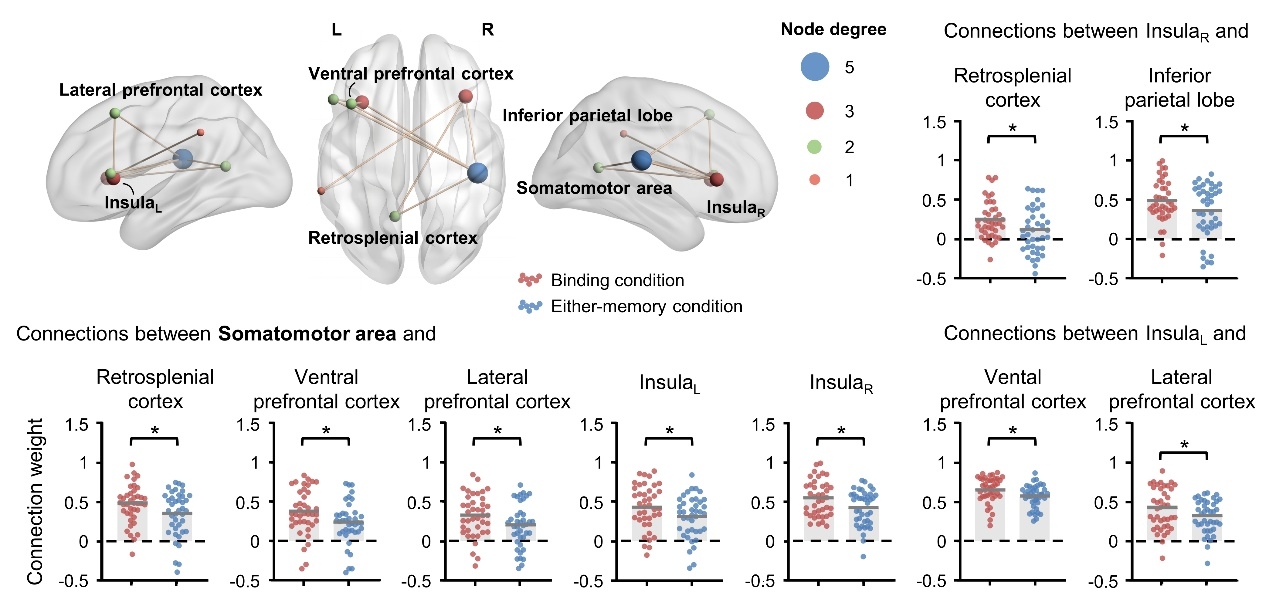
We found that standard univariate activation contrasts did not clearly separate the binding process. Instead, the key difference emerged at the network level. Feature binding was associated with a dedicated “central workspace” centered on the somatomotor area, insula, and prefrontal cortex, showing higher local efficiency and stronger internal connectivity. Importantly, connectivity within this workspace significantly related to behavioral performance. The somatomotor area also showed a shorter intrinsic timescale, suggesting a potentially earlier and faster role in binding-related integration.