Learned statistical regularity modulates anticipatory micro-saccades toward suppressed distractor locations | Nature Communications online
Have you ever been distracted by your phone buzzing while trying to focus on a task? One reason we can maintain attention is that the brain learns statistical regularities in the environment and uses this knowledge to reduce the impact of predictable distractions. However, a longstanding debate concerns how this learned suppression is implemented: Does the brain proactively avoid likely distractor locations, or does it first attend to them and then suppress them?
In a study published in Nature Communications, members of AM-lab combined eye tracking and electroencephalography (EEG) to investigate this question. Their findings provide direct evidence for a reactive suppression mechanism. Before a visual search display appeared, participants' micro-saccades were consistently biased toward locations where distractors were most likely to occur. Rather than avoiding these locations, participants appeared to proactively monitor them. This oculomotor bias was absent in a control experiment and predicted faster visual search performance, indicating that it is a behavioral signature of learned suppression.
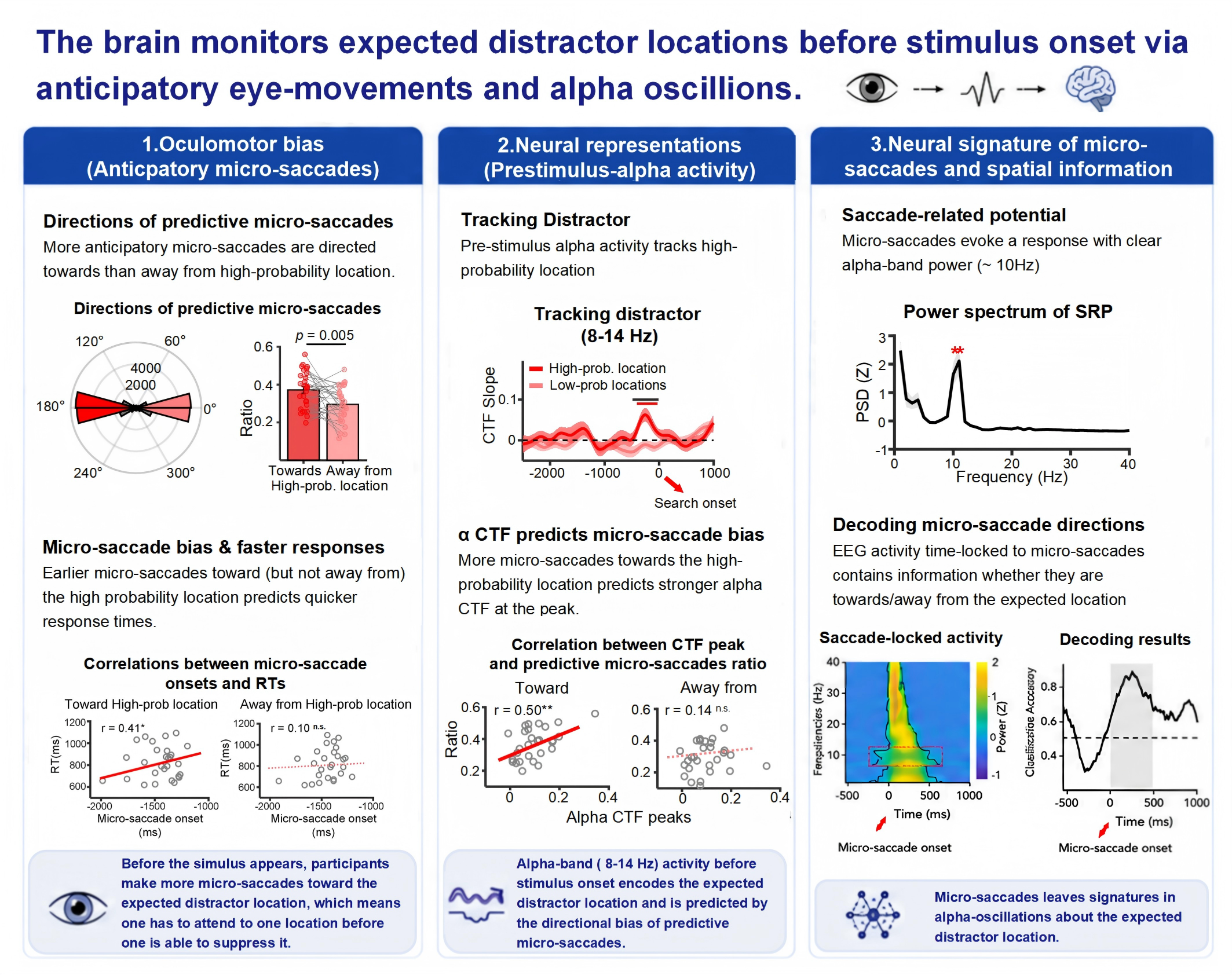
EEG analyses further revealed that pre-stimulus alpha-band activity (8–14 Hz) encoded the spatial location of high-probability distractors. Stronger alpha-band representations were associated with stronger micro-saccade biases toward these locations. In addition, micro-saccades were linked to specific neural activity patterns that carried information about distractor location, suggesting a close interaction between oculomotor preparation and neural oscillatory processes.
Together, these findings support a reactive account of learned suppression. After acquiring statistical knowledge about distractor locations, the brain first directs covert attention toward the expected distractor position, forms a spatial representation through alpha-band neural activity, and subsequently suppresses the distractor efficiently. This work establishes a mechanistic link between anticipatory eye movements and neural oscillations, providing new insight into how statistical learning shapes visual attention and suppresses distraction.